
Home › Renovating from abroad › Step-by-step guide
Guide · Published 17 November 2026How to Renovate Your Algarve Home From Abroad: A Step-by-Step Guide
You do not have to live in the Algarve to renovate a home there. You need a team you can talk to in your own language, someone to see the property for you, a written scope and a clear way to get updates. This guide walks through the whole process, and the mistakes that cost owners abroad the most.
Free inspection · Standard enquiries answered within an hour · Licensed (IMPIC 125351) and insured · Available 7 days a week · We work in English
Or send us an enquiry
What changes when you renovate from far away
You cannot pop round to look at a wall, choose a tile in a shop or let the plumber in. Every question a neighbour on site would settle in five minutes becomes three messages and a lost day. So renovating from abroad is mostly a question of organisation: decide early, write things down, and have one person who answers for the whole project.
Step 1: Gather what a builder needs
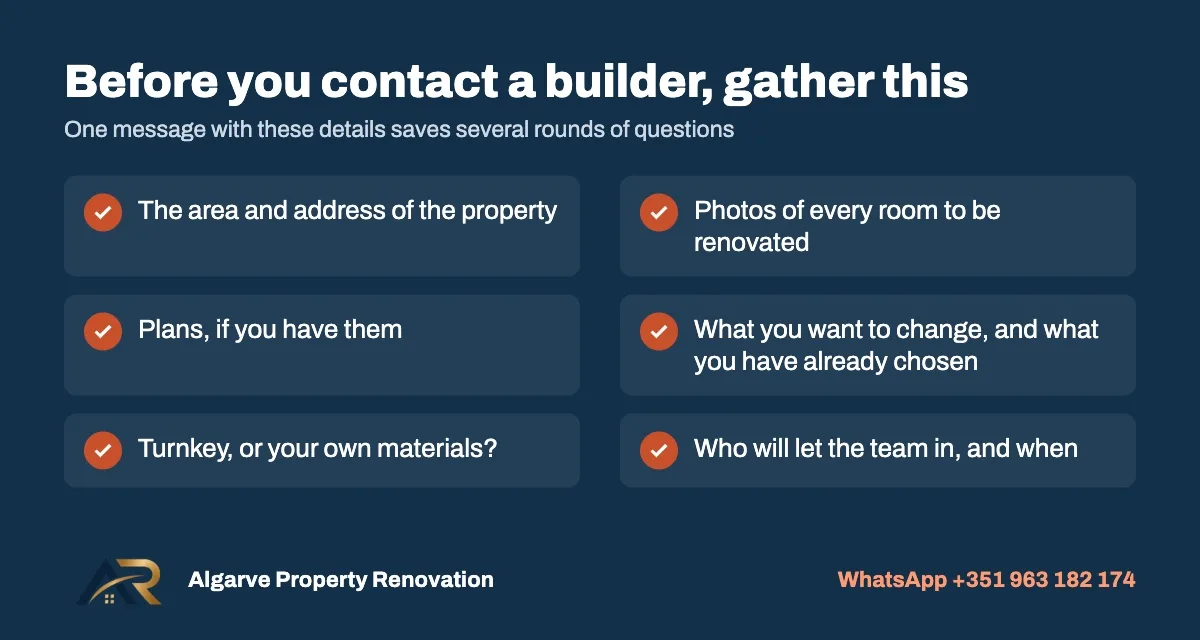
Send one good message instead of ten small ones. Collect these before you contact anyone:
- The area and address of the property.
- Photos of every room that will be renovated, and of the outside if it is part of the job.
- Plans, if you have them.
- What you want to change, and anything you have already chosen.
- Whether you want turnkey work or plan to supply some materials yourself.
- Who can let the team in, and when.
Step 2: Send a short brief
Message the builder on WhatsApp with the photos and a few lines. You do not need technical language. "Two bathrooms, a new kitchen, repaint everything, the wiring looks old" is enough to start. A standard enquiry to us gets a reply within an hour.
Step 3: Check the licence before you go further
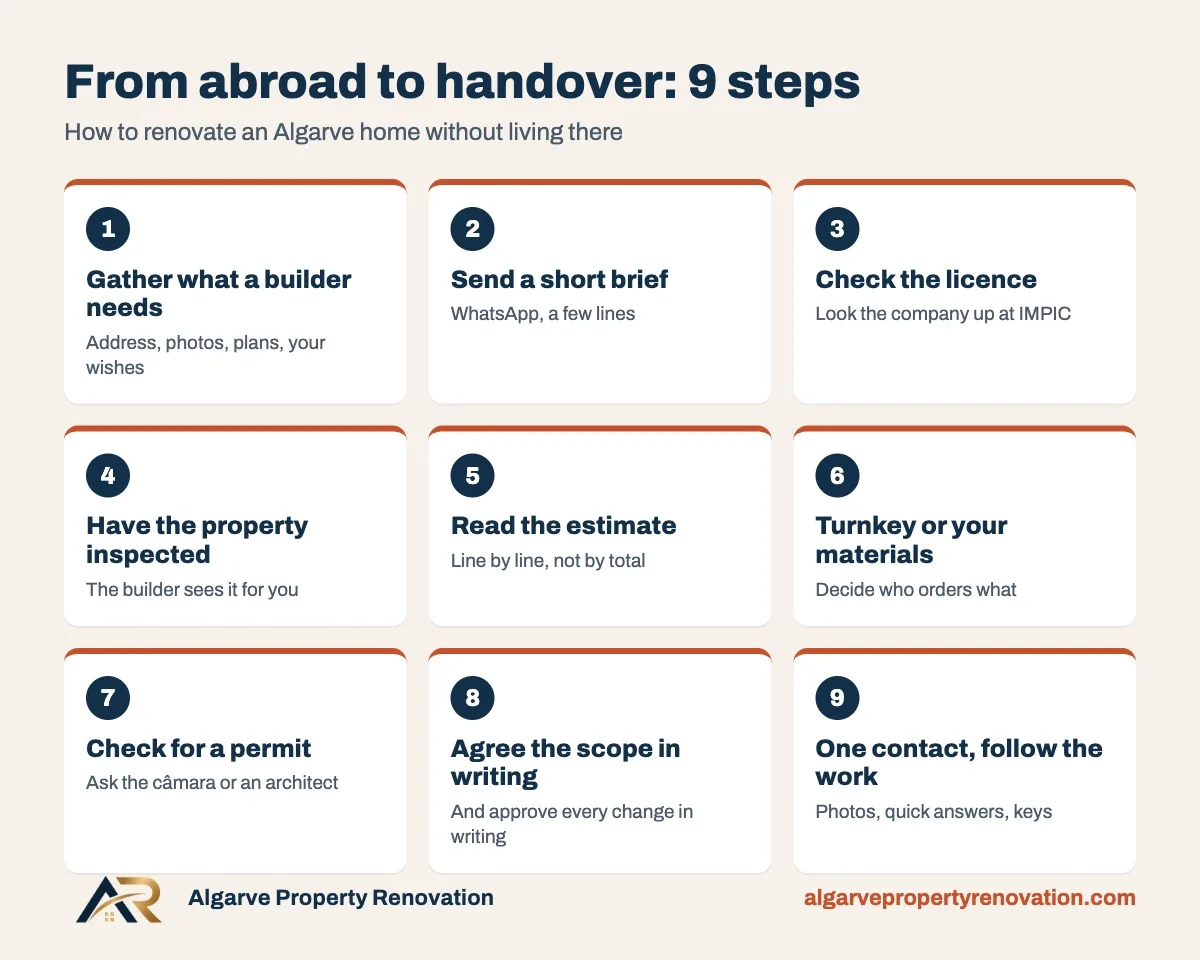
In Portugal, construction work is carried out by licensed companies, and the licence holders are listed by the regulator, IMPIC. Ask for the licence number, then look the company up on the IMPIC list of licence holders for private works (the page is in Portuguese). Check that the name matches the quote. Licences can be cancelled, so check again on the day you sign, not a month earlier. We hold a construction licence (IMPIC 125351) and we are insured.
Step 4: Have the property inspected
Someone has to see the property in person. The builder does that for you, so you do not need to fly in. We arrange a free inspection, look at the property and listen to what you want. If you want someone there on your behalf, a family member, a neighbour or a property manager can let us in.
Step 5: Read the estimate line by line
We prepare your estimate after the inspection, from 24 hours. Whoever you choose, check that it lists the rooms, the works in each room, who supplies which materials and what is not included. Compare quotes line by line, not by the total. A low total with a short list of works usually covers a smaller job.
Keep a reserve for what no inspection can show. Opening a wall can reveal old wiring or tired pipes. Ask your builder how unexpected findings are handled: do they stop, show you photos and agree the extra work with you before going on?
Step 6: Decide turnkey or your own materials
- Turnkey: the builder handles the work and the materials.
- Your materials and equipment: you buy what you have chosen, and the builder carries out the work.
Decide before the start, because it changes who orders what, and when. If you supply materials, agree where they will be delivered and who receives them.
Step 7: Check whether you need a permit
It depends on the work and on the municipality. As a rule, interior changes that do not touch the structure or the facade are the easiest case, while structural changes and facade work usually need approval, and listed buildings have extra rules. Ask your câmara municipal or an architect before you start. The consumer organisation DECO has a useful overview of permits for home works (in Portuguese). A good builder will tell you honestly if a job looks like it needs one, but the decision belongs to the council. In an apartment building, also ask the administrator about the building rules and working hours.
Step 8: Agree the scope in writing
Before work starts, the scope should be written down and agreed: what will be done, what will not, and who is responsible for what. Keep it in a document or a chat you can find later. Agree how and when you pay, and tie the payments to stages of the work. When changes come up during the job, approve them in writing too, in the same chat.
Step 9: Choose one point of contact, then follow the work
A project with several trades is easier when you deal with one person. With one general contractor running the building work, the electrics and the plumbing, you have one chat, not three. See general contractor in the Algarve.
- Agree the rhythm: how you will get updates, for example photos and a short summary after each stage, and a time of day that works for both time zones.
- Plan access and keys: who holds them, and who is on site when the team arrives.
- Answer fast on the small things: tiles, taps, handles, light fittings, paint colours. Small decisions can hold up a job as much as big ones. If the team needs an answer and you reply two days later, the work waits.
- Compare photos with the scope: raise questions early, when they are cheap to fix.
- Keep a local contact: a neighbour or property manager who can open the door in an emergency.
At the end, go through the result against the agreed scope. Ask what warranty applies to the work and what it covers. We give a warranty on our work as provided by law.
Plan around the season
Summer is the busy season for holiday lets, and winter rain can slow outdoor work. If your project includes the roof, the facade or the garden, plan the dates with that in mind and book early.
Mistakes owners make when renovating from abroad
- Starting with no written scope. Everyone remembers the job differently a month later.
- Choosing by the lowest total. Without a comparison of the works, you are comparing different jobs.
- Dealing with every trade directly. Nobody owns the whole project.
- Changing the plan by phone and not confirming it in writing.
- Leaving the small decisions to the last minute.
- Waiting for your next visit to start. The inspection does not need you there.
How we work with owners abroad
We communicate in English, from the first message to the handover. A standard enquiry gets a reply within an hour, the inspection is free, and we prepare your estimate after it, from 24 hours. Work can start within 5 days of your approval. Electrical work is done by our licensed and certified electrician and plumbing by our licensed plumber. See renovating from abroad, how we work and our English-speaking builder page.
Planning a renovation from abroad?
Send us the area, a few photos and a short description. We arrange a free inspection and agree the scope with you. Message us on WhatsApp or book a free inspection.
Further reading
Questions
Can I renovate my Algarve home without visiting?
Yes. Send photos and a short description on WhatsApp. We arrange a free inspection and agree the scope with you.
Do I need to be there during the work?
Not necessarily. Agree one point of contact, how you will receive updates, and how you approve changes.
How do I check that a builder is licensed in Portugal?
Ask for the licence number and look the company up on the IMPIC list of licence holders. Check that the name matches the quote, and check again when you sign.
Do I need a permit to renovate?
It depends on the work and on the municipality. Interior changes are usually the easiest case, structural and facade work usually need approval. Ask your câmara municipal or an architect before you start.
Can I supply my own materials?
Yes. We work turnkey, or with materials and equipment you supply. The scope is agreed at the inspection.
How soon can work start?
Work can start within 5 days of your approval.
How much will it cost?
It depends on the size, the condition, the scope and the materials. For a first range, try the budget calculator. The inspection is free, and we prepare your estimate after it, from 24 hours.